
Does even what you used to enjoy feel heavy?
Most of us have been taught that progress comes from staying in control —pushing harder, constantly optimizing, and always doing more. But when every day becomes something to prove, even the things you once enjoyed can start to feel heavy.
Maybe making progress shouldn't burn you out.
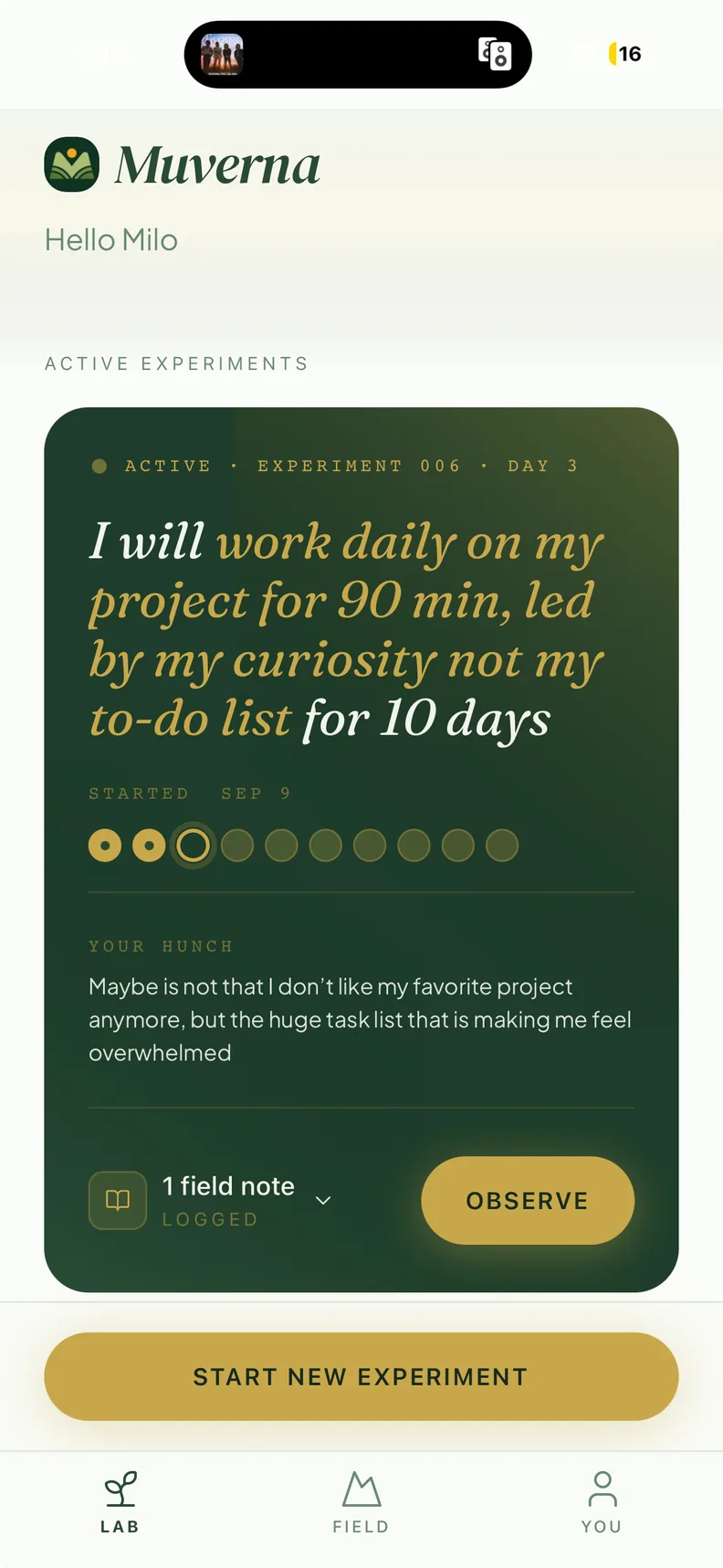

What Becomes Possible
Imagine moving forward without carrying so much pressure.
Take action without having it all figured out
You don't need to know the perfect path before taking the first step. You discover it by moving.
Notice instead of judging
Every observation teaches you something. Every setback becomes information instead of self-criticism.
Learn and adjust instead of pushing harder
You stop trying to control every outcome. You learn from reality, adjust, and keep moving forward.
How Growth Happens
Growth feels different when you lead with curiosity, not control.
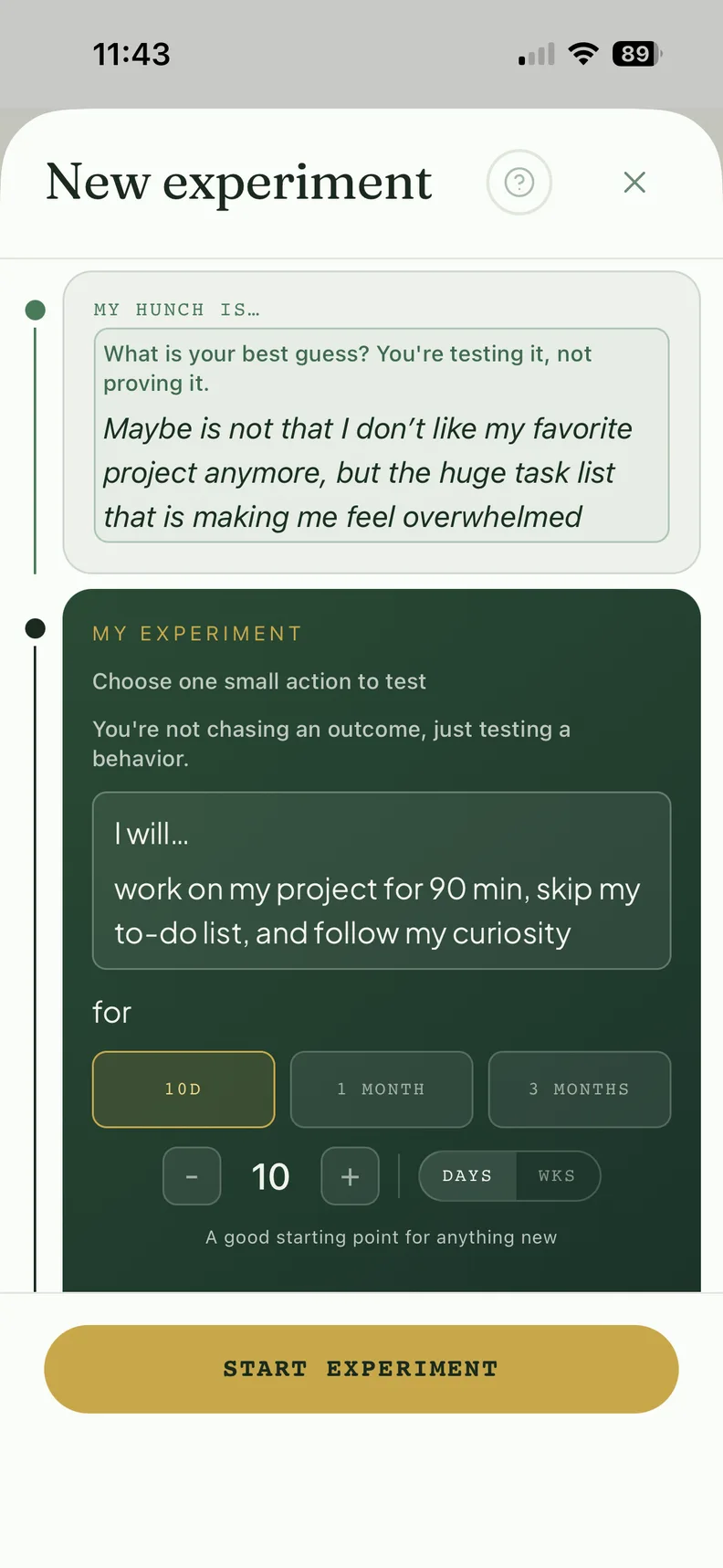
Step 01 · Experiment
Start with a question. Try something. See what happens.
You don't begin by chasing certainty. You begin with curiosity, then let real life to provide answers.
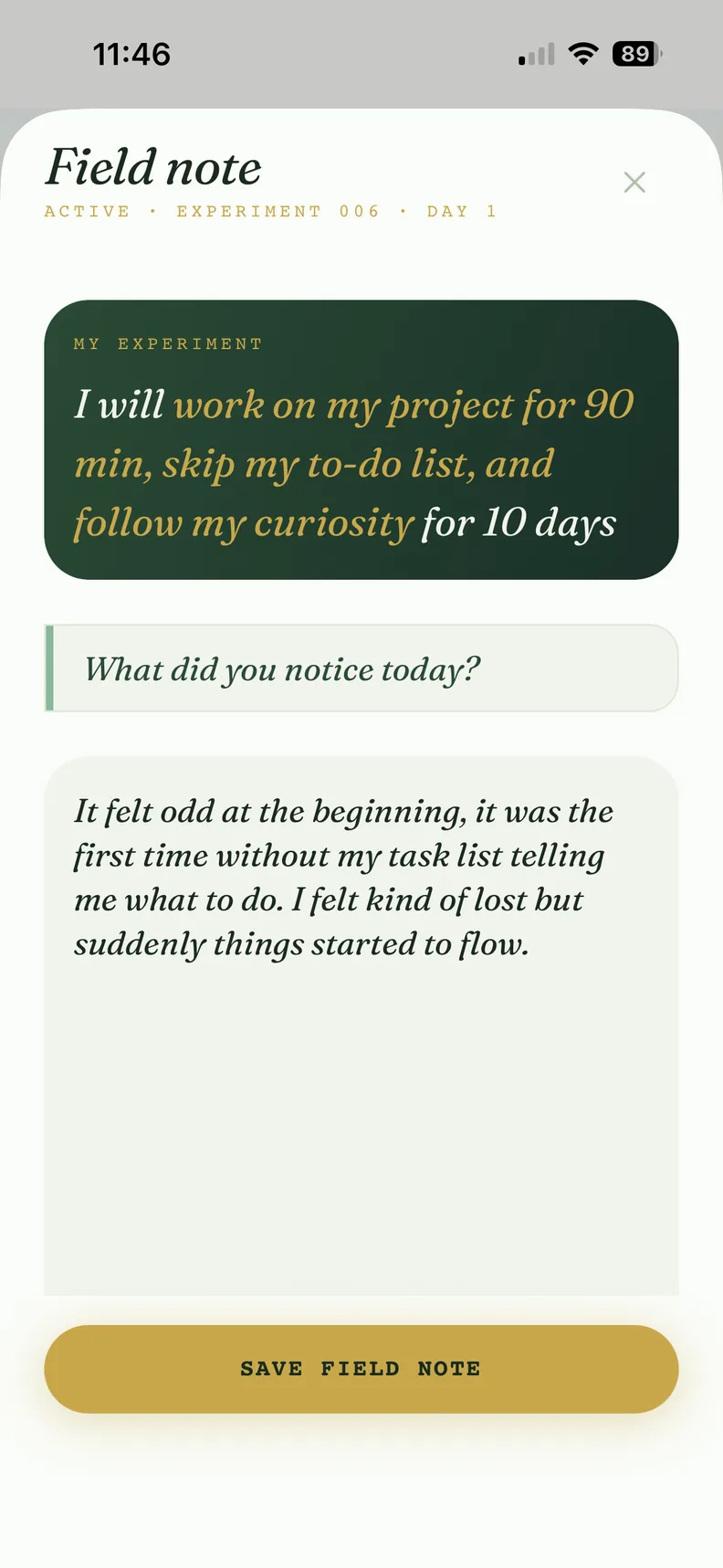
Step 02 · Observe
Pay attention to what happens.
Capture what you notice, without judging the outcome. Start becoming an observer of your own life.
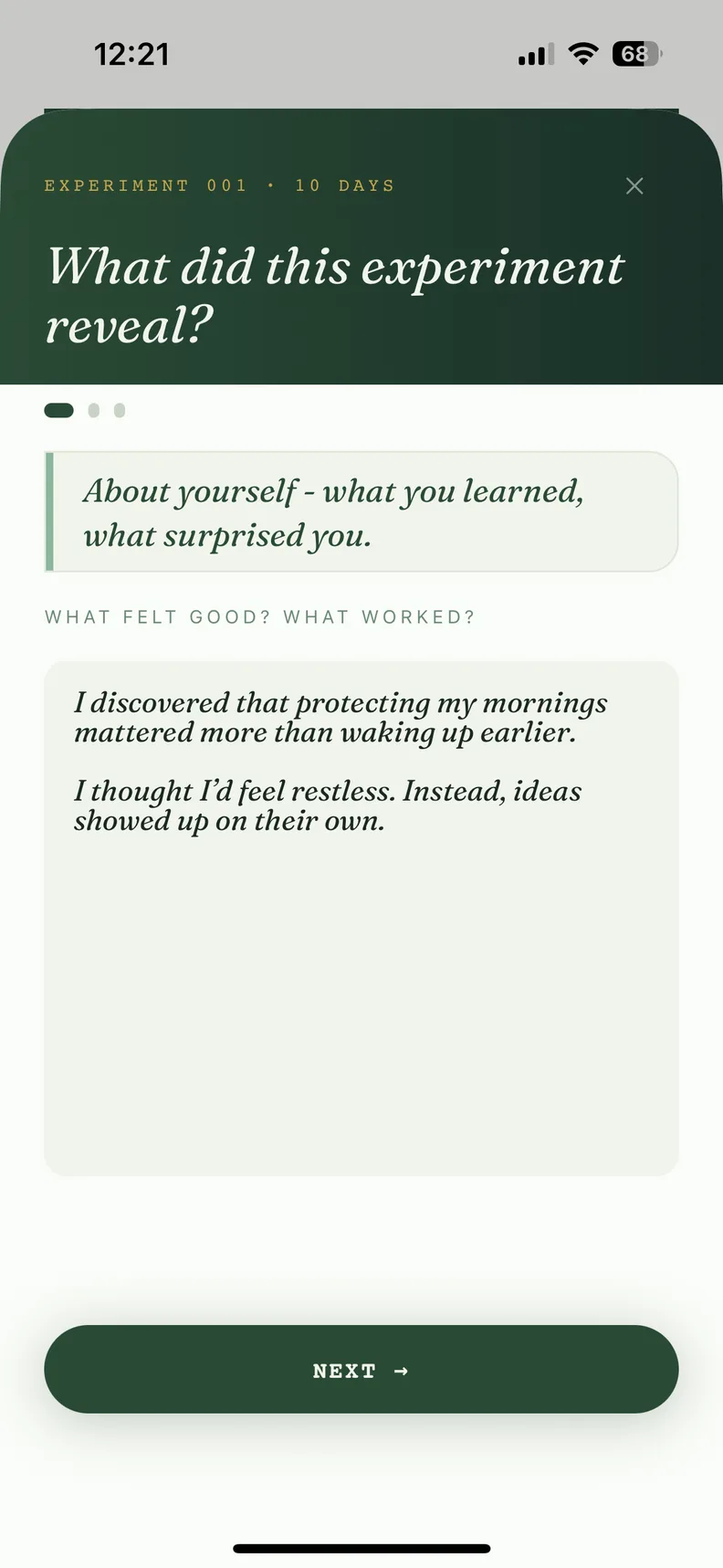
Step 03 · Learn
See what you learned.
Look at what worked, what got in the way, and what sparks your curiosity now.
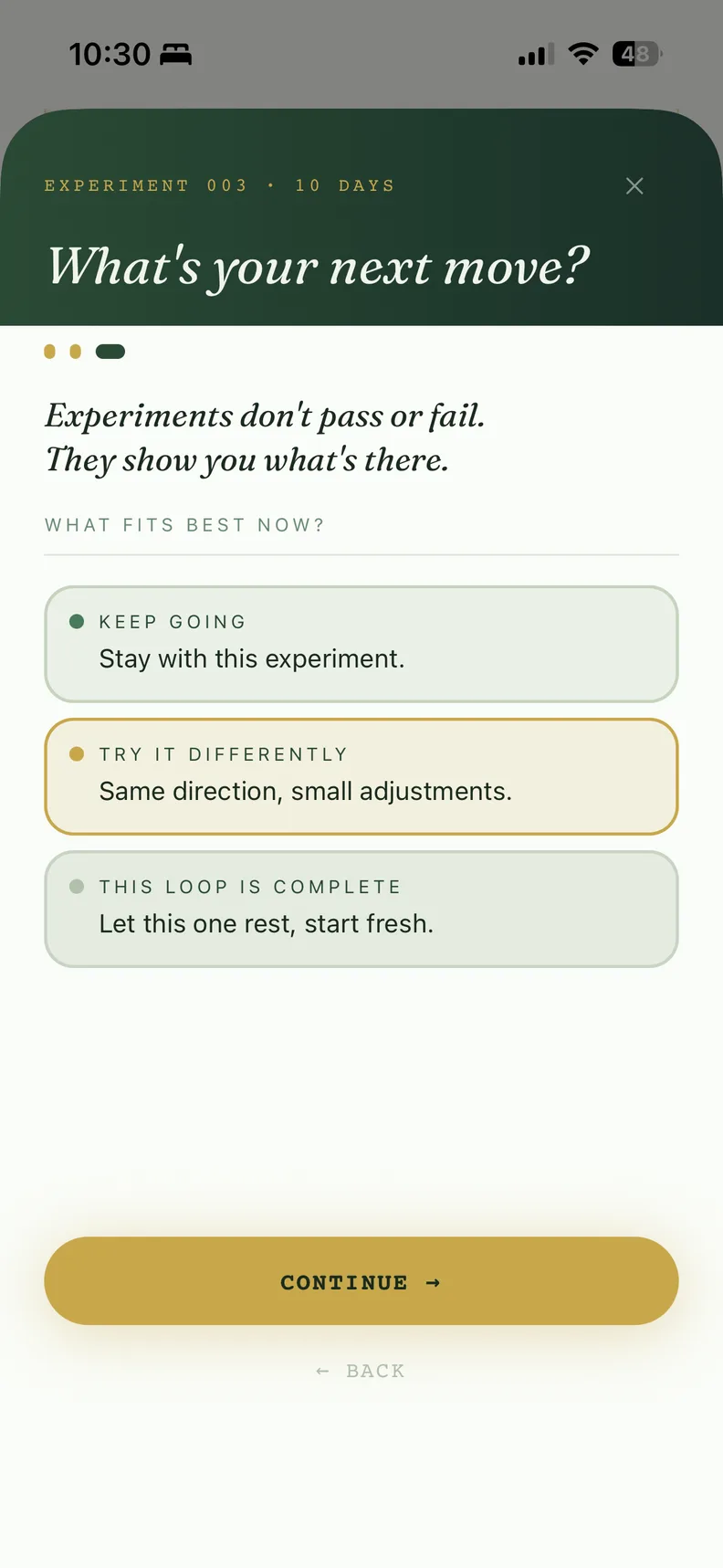
Step 04 · Choose
Decide where to go next.
Every experiment gives you new information. Use it to decide what makes sense for you now.
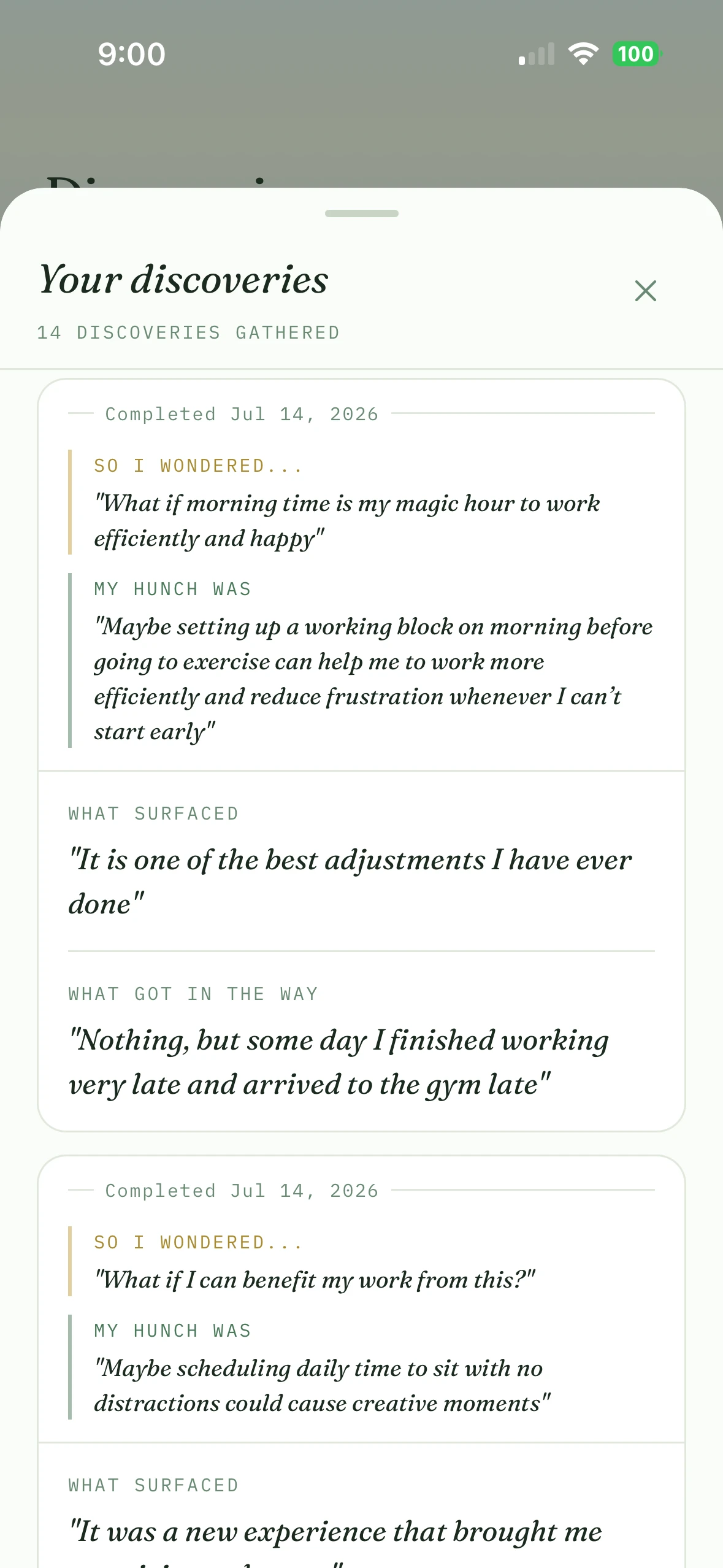
Step 05 · Discover
Start seeing what really works for you.
Each experiment explores a part of your world. Over time, your observations start to reveal a clearer picture of who you are.
From control to curiosity
Your path becomes clearer as you pay attention.
The Control Mindset
"I'll move once I know the right path."
- Wait for certainty
- Follow the plan
- Judge the result
Pressure grows.
The Curiosity Mindset
"I'll discover the path by moving."
- Ask a question
- Try something small
- Observe what happens
Progress grows.
Loosening control isn't giving up.
It's working with how growth actually happens.
Psychological research has been pointing in the same direction for decades.
Why these principles work
Muverna is built on principles that decades of psychological research have linked to learning, wellbeing, and sustainable growth.
Curiosity
Curiosity is consistently associated with greater wellbeing, creativity, engagement, and personal growth. It helps people move forward even before they have all the answers.
Observe without judgment
Paying attention without immediately evaluating yourself helps you stay open to new information, learn more effectively, and respond with greater flexibility.
Reflect to discover
Writing about your experiences helps transform them into understanding. Decades of research show that structured reflection supports insight, emotional processing, and self-understanding.
Systematic Review (2023) ↗ · Foundational Research (Pennebaker) ↗
Evidence gives confidence. Your own experience reveals what works for you.

Juan José Islas Aparicio
Why I built muverna
Have you ever pushed harder, become more disciplined, optimized every habit—and still felt like it wasn't enough? I know that place. I lived there for years.
I'm Juan José Islas Aparicio — a recovering control-based productivity addict.
I was doing everything "right."
I built rigid systems for everything: my mornings, my goals, my routines, my personal growth. I followed every rule I created for myself and pushed even harder whenever I felt behind. I was disciplined with good habits. I was spending my time doing things I cared about—leading high-performing technology teams, building products, reading, learning, and pursuing photography.
Yet I wasn't enjoying any of it anymore. I always felt like it wasn't enough.
I realized the problem was never my effort. It was the belief that progress had to be strictly controlled.
Looking back, the best moments of my life never came from following a plan. They came from following my curiosity.
In 2019, curiosity took me across Southeast Asia with a camera, that trip changed my life. Around the same time, I started recognizing that many of the best things in my career had also come from experimentation rather than certainty. I had already experienced the power of experimenting, I just didn't know how to make it a way of living.
While searching for a different way to grow during a burnout period in my life, I discovered the experimental mindset and Anne-Laure Le Cunff's work. It gave language—and research—to something I had already begun discovering through experience.
Everything changed when I stopped asking, "What goal should I achieve?" and started asking, "What will I explore today?"
That simple shift replaced pressure with curiosity. Instead of trying to control every outcome, I started paying attention to what reality was teaching me.
Instead of creating a rigid timeline for building an app, I ran an experiment:
"I will spend 90 minutes every day building a tool for my own experimental life for 30 days."
At the end, I didn't just have a prototype. I had rediscovered how much I loved creating technology.
Muverna is my biggest experiment so far, and now it's ready to become part of someone else's story.
Corita Kent's quote is now a mantra for me:
"Consider everything an experiment."
Timeless ideas behind Muverna
Different cultures, philosophers, psychologists, and educators have arrived at a remarkably similar insight: growth doesn't come from controlling life—it comes from engaging with it.
Aztec Philosophy
Stay rooted in reality.
The Aztecs described life as living on "slippery earth." Since the world is always changing, wisdom comes from becoming well-rooted in reality rather than trying to control it.
Source ↗Marcus Aurelius
Observe reality before trying to control it.
In Meditations, Marcus Aurelius reminds himself that life is in constant change. Wisdom begins by seeing reality clearly, accepting what you cannot control, and acting well within what you can.
Source ↗Carl Rogers
Understanding creates change. Judgment gets in the way.
One of the pioneers of humanistic psychology, Rogers showed that lasting growth begins when people feel safe enough to understand themselves instead of judging themselves.
Source ↗William James
Ideas become meaningful when they work in real life.
James helped establish pragmatism: understanding comes from experience, action, and testing ideas against reality—not from seeking perfect certainty first.
Source ↗What will I explore today?
Maybe that's a better question than, "How can I do more?"
Start my first experiment- Free for 14 days
- We'll remind you before your trial ends.
- Built around curiosity, not pressure.